


There has been a lot of movement and worry regarding the bond market and the “risk-free” nature of Treasuries. There’s no question that the amount of debt is tremendous. So much that most of us can’t even comprehend it (or afford to resolve it!).
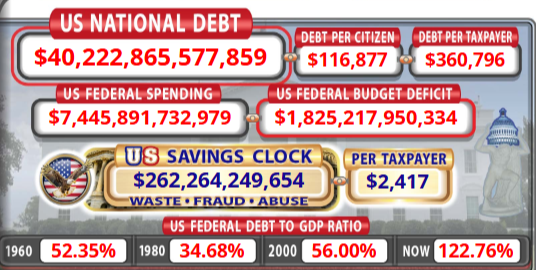
Interest is now well over $1 trillion a year. That must come from somewhere. As shown above, we are running a $1.8 trillion deficit by spending nearly $7.5 trillion per year. Which means we are “only” bringing in $5.8 trillion in revenue.
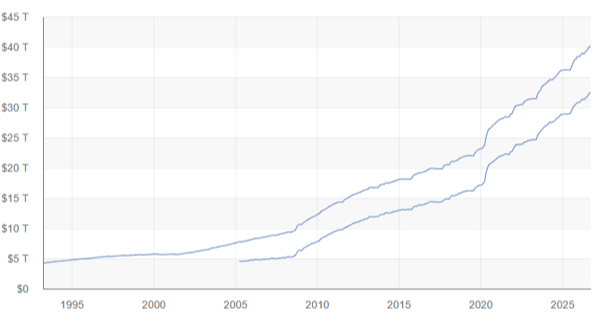
No matter who I talk to, regardless of what political letter you put after your name, everyone agrees that this is unsustainable. And frankly not where things used to be. See the chart below to look at the deficit over time.
Looking at it another way, below is a chart illustrating our debt relative to the size of our GDP (Gross Domestic Product). You can see that as it declined (expectedly) post-WWII, debt-to-GDP got as low 30%. Even during the Clinton administration, it was around 55%. Since the Great Financial Crisis (GFC), it has gone from 64% to 122%.
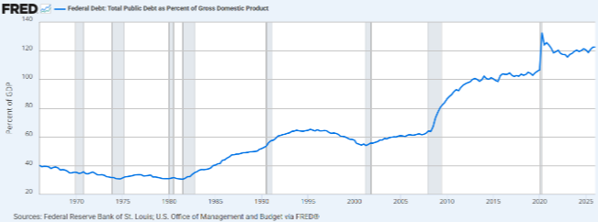
That’s a big hole to climb out of. In fact, Ken Rogoff and Carmen Reinhart published a paper in 2010 entitled ‘Growth in Time of Debt’. In it, they argued that >90% debt-to-GDP results in less than half the growth in GDP as would be expected. In other words, it’s harder to “grow” your way out of the debt when it is that high.
Now if you’re continuing to add to that debt on a yearly basis, there’s seemingly no chance that you will get that number down. In fact, the Committee for a Responsible Federal Budget just published a blog about higher debts and corresponding higher interest rates. If you’re so inclined, you can read the blog here.
To summarize the Committee said that a 1% increase in interest rates would put the debt-to-GDP at roughly 222% in 2056.
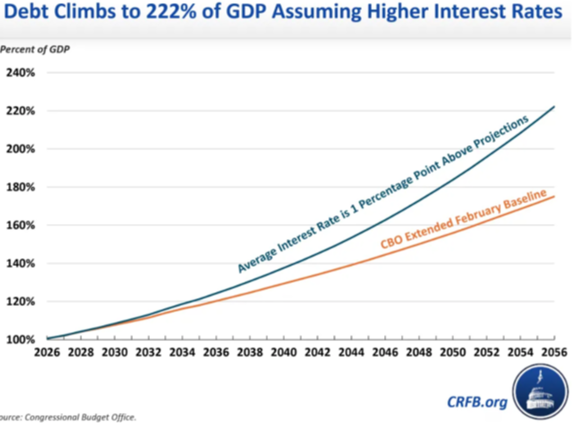
The key to this is that higher interest rates paid by the government, all other things staying the same, would cause our deficit and our debt to go much higher over the next 30 years. Will the economy survive that type of scenario? I would say it’s not likely, but I’m also not sure that we will go there. Why? Because politicians are great at “coming to the rescue” of whatever problem comes about – even if they are the ones to cause the problem to begin with.
Interest rates have gone up a lot over the last six months to a point where they’re starting to become an issue.
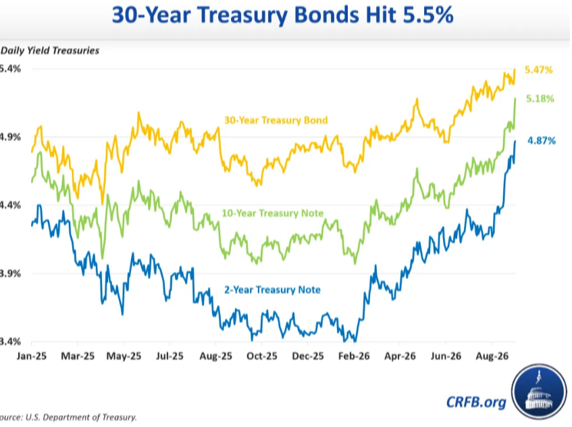
Why are rates going higher? The easy answer is supply and demand. Investors are demanding a higher rate in order to buy the current offering of treasuries. That of course is very simplistic (though not untrue). The more complicated answer involves two things in my view.
The first is the “crowding out effect,” which is the idea that treasuries compete with other bonds for investment in people’s portfolios. It’s no surprise that companies have been issuing a lot of debt to pay for the AI buildout. The “hyperscalers” alone have issued $346 billion in debt, equity, and special purpose vehicles to fund those projects. Here’s a breakdown from Yahoo Finance.
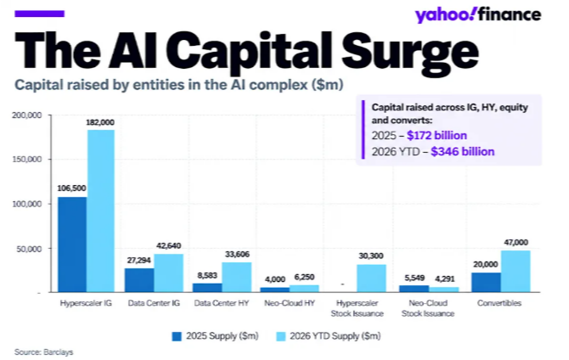
Those bonds have to be bought by someone. And that someone might normally buy treasuries, but some of that allocation may be directed toward these bonds If you want to read the quick article, click on this link.
The second thought is that “bond vigilantes” are trying to force the government into a more sustainable path. First, we need to define the term.
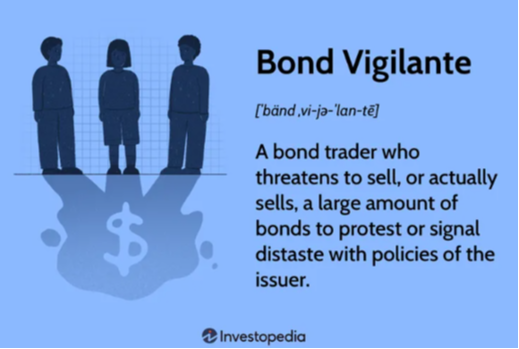
Well that certainly fits into my narrative. By selling or not buying the same amount of treasuries, they are pushing rates higher (lack of demand). Meanwhile, supply is at the same level or higher given the disastrous state of the federal budget. That all points to higher rates.
If the distaste for current policies is real (which it is from everyone I talk to) then forcing the government to get closer to a balanced budget is the answer. In fact, Treasury Secretary Scott Bessent recently reiterated his “3-3-3 plan.” 3% growth, an increase of 3 million barrels of oil per day, and a fiscal deficit of 3% to GDP. Would that be helpful and cause interest rates to go down? I think so. Today we are at 5.5% deficit to GDP, so we would need to cut nearly half of the deficit. Now the big question…”How?” Here are the largest budget items.

Of our $7.4 trillion government budget, nearly $5.8 trillion is in these four categories. That means there’s only an additional $1.6 trillion outside of these categories. Of the $1.6T, we would have to cut $841 billion from that (basically half) to get to 3%.
The biggest problem is I don’t see any politicians working toward that end. You can say it’s all one party or the other, but both have responsibility for where we are at. And if you think WE are going to get off free from responsibility, we have the ultimate responsibility to vote in the people that will carry out our wishes. As we head into the elections, keep that in mind.
Now to step onto my soapbox as we conclude. If we continue to vote for the people who will give us what we want rather than what we need, we shouldn’t expect anything other than what we vote for. I would argue that Kennedy’s famous line, “Ask not what your country can do for you, but what you can do for your country” has never been more critical. If we don’t fix this, we will surely pay for it many times over down the road.
Happy to have a conversation about this or any other topic. Have a good rest of the week.